Full Stack Development
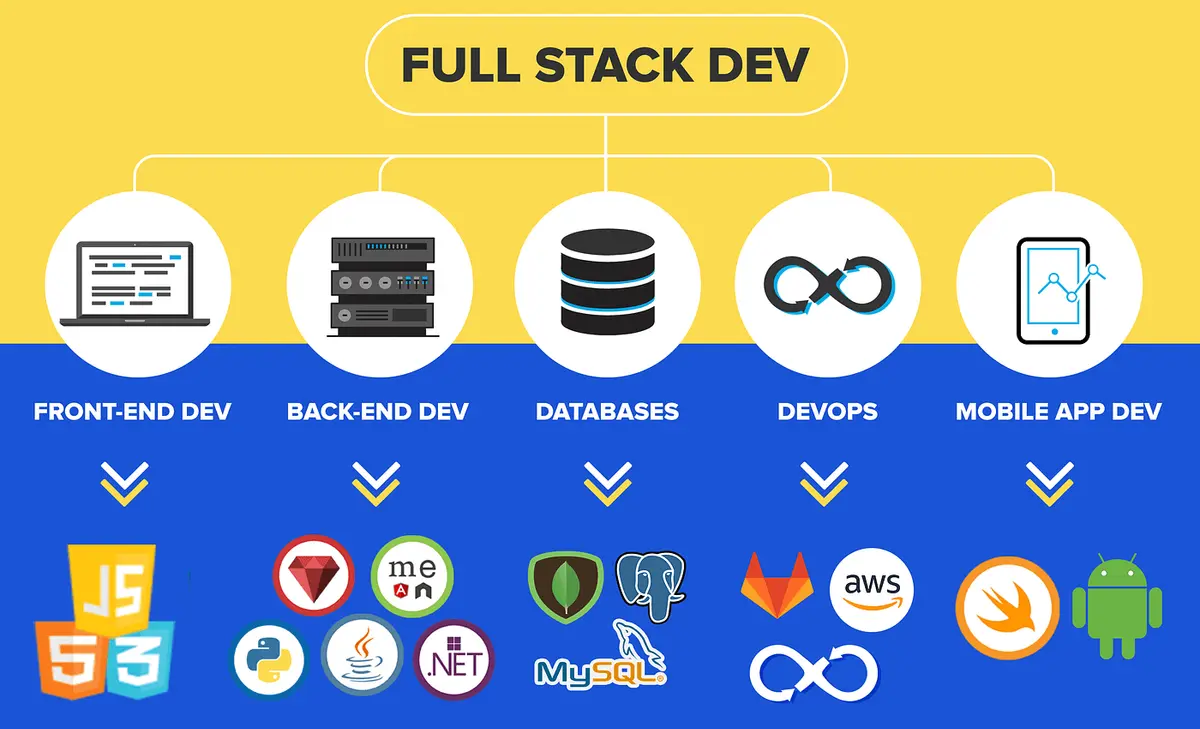
Full Stack Development refers to the practice of working on both the front-end (client-side) and back-end (server-side) of a web application. A full stack developer is a generalist who understands how a website functions from the user interface down to the database, bridging the gap between design and data.
Here is an abstract breakdown of how full stack development works for a beginner.
1. The Full Stack Concept
To understand the "full stack," it helps to think of a web application as an iceberg.
The Top of the Stack (The Frontend): This is the visible part of the iceberg above the water. It encompasses everything the user can see, click, and interact with in their web browser.
The Bottom of the Stack (The Backend): This is the massive, hidden part of the iceberg beneath the water. It contains the server, application logic, and databases that power the application but remain hidden from the end user.
A full stack developer is capable of diving into both environments, ensuring that the visual interface seamlessly communicates with the hidden infrastructure.
2. Component Breakdown
A standard full stack architecture consists of three fundamental layers that interact sequentially:
The Presentation Layer (Frontend)
This layer handles user experience and interface design. It is built using HTML to structure content, CSS to style it, and JavaScript to make it interactive. When a user fills out a signup form, they are interacting exclusively with the presentation layer.
The Logic Layer (Backend)
This layer processes the inputs received from the presentation layer. Written in languages like Python, Node.js, or PHP, the backend application applies business rules. For example, when that signup form is submitted, the backend verifies if the password is long enough and checks if the email address is already taken.
The Data Layer (Database)
This layer acts as the long-term memory of the application. It stores user profiles, product catalogs, and transactional records using database management systems like PostgreSQL, MongoDB, or MySQL. The backend logic layer queries this data layer to retrieve or update information as requested by the user.
3. Communication: The "Glue" of the Stack
The frontend and backend do not automatically know how to talk to each other. They communicate through APIs (Application Programming Interfaces) and network protocols, most commonly HTTP (HyperText Transfer Protocol).
When an action occurs on the frontend, it sends an HTTP request containing data to the backend. The backend processes the request, interacts with the database if necessary, and sends back an HTTP response—often formatted as raw text data called JSON (JavaScript Object Notation). The frontend then reads this data and updates the screen without requiring a full page reload.
4. Popular Software Stacks
Full stack developers often specialize in specific technology combinations called "stacks." These stacks are grouped together because they complement each other well and streamline the development process.
One of the most famous examples is the MERN Stack, which consists entirely of JavaScript-based technologies:
MongoDB (The Database)
Express.js (The Backend Framework)
React (The Frontend Library)
Node.js (The Backend Runtime Environment)
By using a unified stack like MERN, a developer can write both the client-side interface and the server-side logic using a single programming language: JavaScript.
5. The Full Stack Mindset
Being a full stack developer does not mean you have to be an absolute expert in every single technology. Instead, it means you have enough cross-functional knowledge to build a complete product from scratch, debug errors whether they happen on the screen or on the server, and understand how architectural decisions on the backend impact the user experience on the frontend.